1. Introduction
Education has transformed dramatically in the digital era. Traditional lecture-based classrooms—once centered on passive listening and memorization—are rapidly evolving into interactive, personalized, and technology-driven learning environments.
Modern learners expect:
- Engagement over repetition
- Personalization over uniform pacing
- Interaction over isolation
- Flexibility over rigid structure
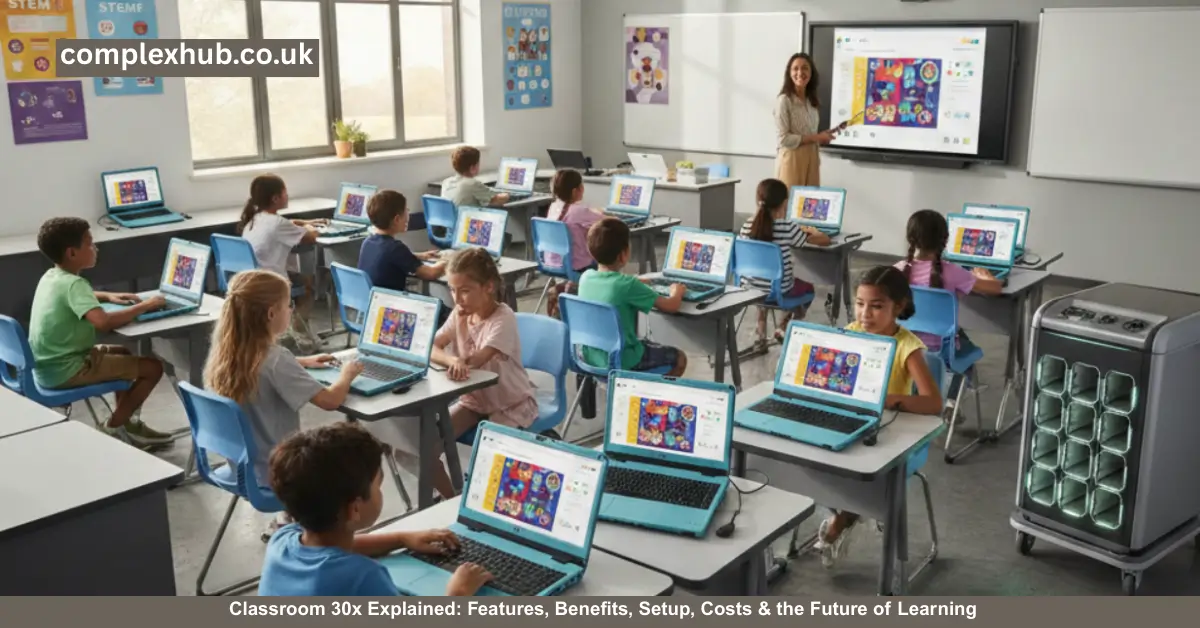
Classroom 30x represents this transformation. The “30x” symbolizes exponential improvement in engagement, personalization, accessibility, and measurable outcomes compared with conventional classrooms.
Rather than a single product, Classroom 30x is a complete educational ecosystem blending immersive technology, adaptive AI systems, real-time analytics, and collaborative design.
This guide explores every dimension of Classroom 30x—from features and setup to costs, measurable results, and the future of learning.
2. What Is Classroom 30x?
Classroom 30x is a next-generation learning environment integrating:
- AI-driven adaptive learning platforms
- Immersive VR/AR systems
- High-performance display and AV technology
- Real-time analytics dashboards
- Hybrid and remote-ready infrastructure
Instead of delivering identical instruction to every student, it focuses on responsive, data-informed, student-centered learning.
Core Principles
- Personalized learning pathways
- Experiential and immersive content
- Flexible collaboration zones
- Continuous feedback and assessment
- Seamless hybrid participation
In short, Classroom 30x transforms classrooms into dynamic ecosystems rather than static lecture spaces.
3. The Five Pillars of Classroom 30x
Classroom 30x rests on five foundational pillars:
- Immersive display and AV technology
- AI-powered adaptive learning systems
- Collaborative digital tools
- Real-time analytics and monitoring
- Hybrid-ready connectivity infrastructure
Together, they enable:
- Active participation instead of passive listening
- Real-time feedback instead of delayed testing
- Personalized pacing instead of one-speed instruction
- Project-based collaboration instead of isolated memorization
These pillars align closely with 21st-century competencies such as:
- Critical thinking
- Creativity
- Communication
- Digital literacy
4. Evolution and Background
Classroom 30x emerged from multiple converging global shifts:
- Post-pandemic demand for hybrid learning
- Rapid advances in AI-based adaptive platforms
- Increased affordability of immersive hardware
- Research supporting experiential learning models
- Growth in cloud-based educational ecosystems
It is not one invention—it is the result of infrastructure, pedagogy, and technology merging into a unified framework.
5. Use Cases Across Education and Industry
K–12 Education
Benefits include:
- Gamified lessons
- Immersive science and history exploration
- Higher motivation and retention
- Collaborative skill-building
Higher Education
Universities can deploy:
- Virtual laboratories
- Simulation-based medical training
- Engineering modeling tools
- Data-driven learning analytics
This deepens mastery in complex disciplines.
Corporate Training
Organizations leverage Classroom 30x for:
- Safety simulations
- Technical skill practice
- Reduced onboarding time
- Hybrid workforce training
Hybrid & Remote Learning
Remote learners gain:
- Equal visual participation
- Interactive collaboration
- Real-time assessment access
This reduces the traditional divide between in-person and online education.
6. Core Features of Classroom 30x
6.1 Immersive Display Systems
Modern display systems include:
- 100+ inch projection or LED panels
- High-resolution visuals (1080p or 4K)
- Flexible throw ratios
- Interactive touch capabilities
These ensure equal visibility and shared engagement.
6.2 AI-Driven Adaptive Learning
Adaptive platforms:
- Monitor performance in real time
- Adjust difficulty automatically
- Offer targeted feedback
- Recommend personalized exercises
Reported improvements commonly include:
- 20–25% assessment score gains
- Faster mastery of weak concepts
- Reduced dropout rates
6.3 VR/AR Integration
Immersive technologies allow learners to:
- Explore anatomy in 3D
- Visit historical civilizations virtually
- Conduct simulated lab experiments
- Practice real-world technical skills
Research consistently shows:
- 20–30% higher engagement
- Improved retention through experiential learning
6.4 Hybrid Infrastructure
Reliable implementation requires:
- Enterprise-grade dual-band Wi-Fi
- Wired backbone connections
- Cloud-based content access
- Secure authentication systems
This ensures seamless in-person and remote collaboration.
6.5 Analytics Dashboards
Real-time monitoring systems track:
- Student engagement levels
- Performance trends
- Device and system health
- Content interaction patterns
Educators can intervene early when learners struggle.
7. How Classroom 30x Is Implemented
Implementation typically follows structured stages:
- Assessment – Evaluate physical space and infrastructure
- Hardware Installation – Displays, AV, VR stations
- Software Setup – Adaptive platforms and dashboards
- Integration – Secure network configuration
- Calibration – Optimize visuals and audio
- Launch & Monitoring – Ongoing data-driven refinement
This phased approach minimizes disruption.
8. Technical Specifications
Key technical benchmarks often include:
- Display resolution: 1080p minimum (4K recommended)
- Large projection formats: 100–150 inches
- Stable networking: Dual-band Wi-Fi + wired backbone
- Devices: Laptops, tablets, VR headsets
- Cloud-integrated learning platforms
Proper calibration and bandwidth planning are essential for consistent performance.
9. Benefits Compared to Traditional Classrooms
Stronger Engagement
Immersive environments maintain attention longer.
Personalized Learning
AI adapts instruction to individual needs.
Improved Collaboration
Digital teamwork builds communication skills.
Accessibility
Remote learners receive equal participation opportunities.
Measurable Outcomes
Analytics provide clear performance insights.
Long-Term Cost Efficiency
Digital content reuse and improved outcomes offset initial investment.
10. Costs of Classroom 30x
Costs vary widely depending on scope.
Entry-Level Hybrid Upgrade
- $20,000–$40,000
Includes smart displays, network upgrades, and adaptive platforms.
Mid-Tier Immersive Setup
- $50,000–$100,000
Adds VR stations, advanced AV systems, analytics dashboards.
Full Immersive Lab Environment
- $100,000+
Includes multiple VR units, simulation software, premium infrastructure.
While upfront costs are higher than traditional classrooms, long-term gains in efficiency and outcomes may justify investment.
11. Real-World Performance Data
Reported outcomes across implementations include:
- 20–30% engagement increases with immersive tech
- 20–25% test score improvements via adaptive learning
- Up to 60% reduction in corporate onboarding time using VR
- Higher hybrid participation rates
These metrics demonstrate measurable advantages.
12. Challenges and Solutions
| Challenge | Solution |
|---|---|
| Budget constraints | Phased rollout & grants |
| Teacher training needs | Continuous professional development |
| Infrastructure gaps | Modular upgrades |
| Equity concerns | Device lending programs |
Proactive planning ensures sustainable adoption.
13. Maintenance & Long-Term Support
Ongoing maintenance includes:
- AV calibration every 3–6 months
- Firmware and software updates
- Network monitoring
- Cleaning and device inspection
Consistent upkeep protects long-term ROI.
14. The Future of Classroom 30x
Education is moving toward:
- Mixed-reality environments
- Predictive AI analytics
- Global virtual collaboration networks
- Standardized immersive ecosystems
Future developments may include:
- Fully immersive mixed-reality classrooms
- AI predicting learning gaps before they occur
- Global shared virtual campuses
Classroom 30x represents not just technological change—but a fundamental pedagogical evolution.
15. FAQs
What classroom size is required?
Flexible display systems support small and large rooms.
Can existing infrastructure be used?
Yes, incremental upgrades are possible.
Do teachers need training?
Yes—professional development is critical for success.
Which subjects benefit most?
STEM, history, vocational training, and language learning show strong gains.
16. Conclusion
Classroom 30x is not a single device or software tool—it is a holistic vision for modern education.
By integrating immersive technology, adaptive intelligence, collaborative tools, and hybrid accessibility, it transforms learning from passive reception into active experience.
For schools, universities, and organizations seeking:
- Higher engagement
- Stronger outcomes
- Future-ready skills
- Data-informed instruction
Classroom 30x offers a powerful path forward—reshaping not just how we teach, but how learning itself is experienced in the digital age.
Read More :- Calesshop