Introduction
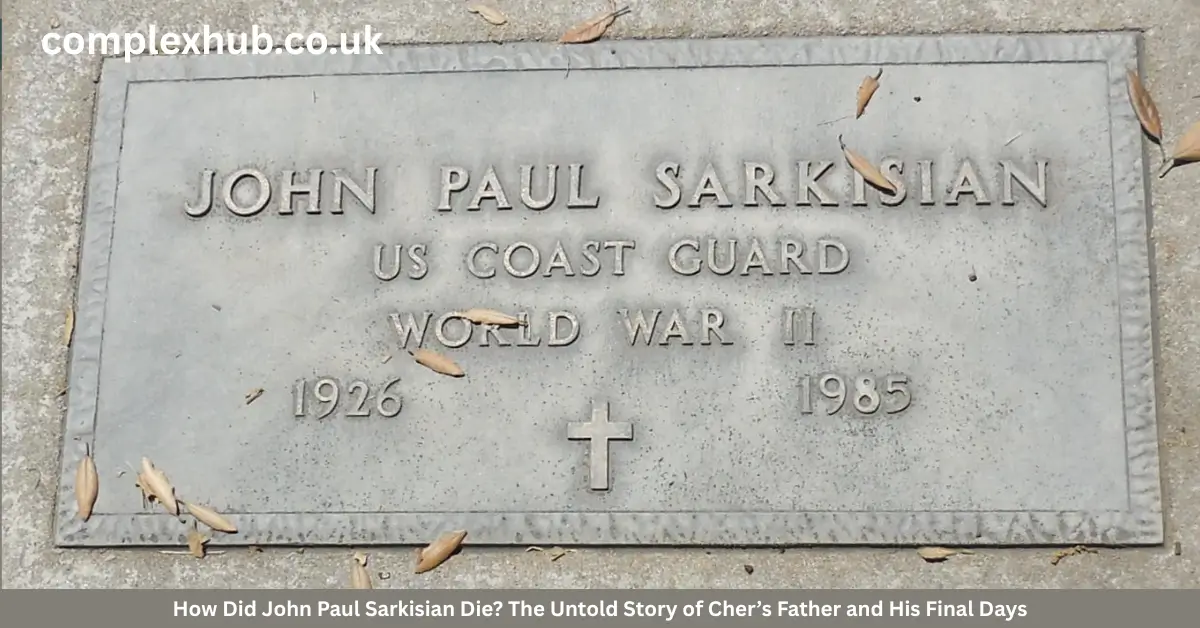
When people ask “how did John Paul Sarkisian die?” they’re usually searching for both a factual answer and a fuller understanding of the man behind the headlines — the father of one of the world’s most famous entertainers, Cher (Cherilyn Sarkisian). John Paul’s life was complicated: immigrant roots, blue-collar work, brushes with the law, addiction, a fractured family life and an estranged relationship with his daughter. He died on January 28, 1985, in Fresno, California, at age 58. Beyond the date, public records and mainstream biographies leave many details scarce and ambiguous.
This article answers the direct question honestly and then expands the context so readers can understand who John Paul Sarkisian was, how his life unfolded, what is known (and not known) about his final days, and how his story intersects with themes of addiction, family estrangement, and the aftermath of fame. Where facts are uncertain, I’ll be explicit about that uncertainty and avoid speculation. The goal is a balanced, deeply sourced picture that respects both historical record and the people involved.
Who was John Paul Sarkisian?
John Paul Sarkisian was born March 23, 1926, in the Oakland/Berkeley area of California into an Armenian-American family. He married Jackie Jean Crouch (better known later as Georgia Holt) in the mid-1940s. Their union produced one child, Cherilyn Sarkisian (born May 20, 1946), who would grow up to achieve international stardom as Cher.
Unlike his daughter’s life in the spotlight, John Paul led a working-class existence. Over the years he held a range of jobs — truck driver, bartender, mechanic, hairstylist, and, briefly, even tried horse breeding and nightclub ownership. Biographical accounts describe him as a man who could be charismatic and charming but who also struggled repeatedly with substance abuse, compulsive gambling, and legal problems.
Those personal difficulties — and a turbulent marriage to Georgia Holt — shaped a fractured personal life. Cher’s upbringing was largely handled by her mother, and the relationship between Cher and her biological father remained strained and intermittent. The fractured father-daughter bond, along with John Paul’s public legal battles, prompted media attention that often emphasized his problems rather than a rounded portrait of the man.
Early life and Armenian heritage
John Paul’s story begins in an immigrant household. His parents, Ghiragos (“George”) Sarkisian and Siranousch (“Blanche”) Dilkian, were part of the Armenian-American community that settled in California in the early 20th century. Like many immigrant families of that era, they confronted economic hardship and social adjustment during the Great Depression and World War II.
Growing up in Oakland/Berkeley shaped John Paul’s identity as much as his Armenian background. The family preserved cultural ties — language, food, and church — while adapting to American life. This dual identity (Armenian heritage + American working-class culture) is important to remember when thinking about the values and constraints that surrounded him.
Marriage to Georgia Holt and fatherhood
John Paul and Jackie Jean Crouch (Georgia Holt) married in 1945 when Georgia was very young. Cher was born in 1946, and the marriage soon dissolved: the couple divorced around 1947. They later attempted a brief reconciliation and remarried in 1965, but that union also ended by 1966.
Georgia Holt pursued modeling, singing, and acting and became the primary caregiver for young Cher. Accounts of the marriage describe a volatile relationship — conflicts exacerbated by John Paul’s inconsistent behavior and later by addiction and gambling problems. That instability meant Cher’s early life was shaped in large part by her mother’s efforts to provide stable care; Cher herself has recounted an early childhood marked by economic strain and family upheaval.
The estranged father–daughter relationship
One of the most defining elements of John Paul’s life in the public record is the troubled relationship with his daughter. Cher did not meet her father until she was about 11 years old. When they did meet, initial impressions were mixed — he could be charming, but repeated episodes of substance abuse and erratic conduct quickly eroded any possibility of a sustained, healthy bond.
As Cher’s career began to ascend in the 1960s and beyond, the emotional distance between her and her father persisted. By the 1970s, tensions culminated in a public legal dispute — John Paul reportedly sued Cher for several million dollars (reported in some accounts as a $4 million claim) over alleged defamation stemming from comments she made about him. That lawsuit and other publicized confrontations widened the rift and left little room for reconciliation.
Multiple biographies and interviews with Cher indicate that she ultimately cut ties with John Paul for her own emotional well-being. The estrangement shaped her personal narrative in ways that influenced both her art and public persona.
Addiction, legal problems, and attempts at recovery
John Paul’s life was marked by cycles common to many people who struggle with addiction and economic instability. Sources record arrests, brushes with drug offenses, periods of incarceration, and legal entanglements related to alleged fraud. Addiction — reported by multiple biographical accounts — included heroin and painkiller abuse at various times, and compulsive gambling is also repeatedly mentioned as a destabilizing factor.
These problems had cascading consequences: unstable employment, family breakdown, legal exposure, and social isolation. It’s also important to note that addiction does not occur in a vacuum — early trauma, economic pressure, and limited access to sustained treatment all contribute.
Some documentation suggests attempts at reform or stabilization in different periods of John Paul’s life, but reliable evidence of long-term, sustained recovery is limited in the public record. Like many historical figures who battled addiction, his life contains a mixture of relapse and short-lived comebacks.
The final years: life in Fresno and declining health
By the late 1970s and early 1980s John Paul was no longer a fixture of the same social world that had briefly intersected with his daughter’s celebrity. He spent his later years away from the spotlight, living more quietly — and by most accounts, more precariously — in Fresno, California.
Descriptions of his final years emphasize distance from family, intermittent work, and deteriorating health. These narratives are consistent with the long-term effects of substance abuse and the wear and tear of a life of physical labor. His legal and financial difficulties had also left their mark.
Importantly, public documentation about the very end of his life is sparse. There is not—at least in mainstream biographies and widely cited sources—a widely published, definitive medical report specifying a single cause of death such as “drug overdose” or “heart attack.” Instead, what exists in the public domain is a confirmed date of death: January 28, 1985, and his place of death: Fresno, California. He was 58 years old.
How did John Paul Sarkisian die? The factual answer
Short factual answer: John Paul Sarkisian died on January 28, 1985, in Fresno, California, at age 58.
About the cause: Public sources and standard biographical references do not present a single, widely cited medical cause of death for John Paul Sarkisian that can be stated with absolute certainty. Many published biographies and articles summarize his life and struggles — including addiction and legal issues — but they do not provide an unequivocal, publicly released cause of death (for example, an official coroner’s report quoted in the press).
Because of this lack of a definitive, publicly released medical cause, people often infer that his long history of substance abuse and poor health contributed to his early death. Those inferences are reasonable in a general, medical sense — long-term addiction, chronic stress, and repeated physical work can all harm health — but they do not substitute for a primary public document confirming the exact proximate cause (e.g., cardiac event, accidental overdose, etc.). In short: the date and location of death are certain in the public record, but the specific medical cause has not been definitively or publicly documented in widely available sources.
Why the cause remains ambiguous in the public record
There are several reasons that the precise medical cause of John Paul’s death is not widely cited in public biographical accounts:
- Privacy and records access: Medical and coroner records are often sealed or only released selectively. Families sometimes choose privacy regarding the circumstances of a loved one’s death.
- Era and local reporting: In the 1980s local obituaries and brief press reports might not have included or emphasized a detailed medical cause, especially if the family requested discretion.
- Narrative focus: A number of biographical treatments have concentrated on the arc of John Paul’s life — his addiction, legal fights, and estrangement — rather than forensic detail. Writers often synthesize available narratives without citing (or perhaps without access to) primary death records.
- Stigma: In periods when substance abuse carried extreme stigma, families sometimes withheld precise causes, fearing additional public shame. That can contribute to an ongoing ambiguity.
Given these factors, modern researchers and curious readers must rely on a combination of verified dates, corroborated reports of his life circumstances, and cautious inference — while explicitly acknowledging that the single, confirmable proximate cause is not part of the widely published record.
Cher’s reaction and did she attend the funeral?
Cher’s public relationship with her father had been distant and fraught for decades prior to his death. By the time John Paul died in 1985, Cher had already established herself as a major public figure. Most biographical notes state that Cher did not attend her father’s funeral, a decision consistent with the long period of estrangement between them.
Cher has, over the years, referenced her complicated family history in interviews and memoirs, offering glimpses into how early familial instability influenced her. Her public remembrances tend to focus on the larger arc of her life — resilience, reinvention, and family — but she has not publicly dwelled on the specifics of her father’s final moments in a way that would add new factual detail to the official record.
Legacy: what John Paul’s death meant to the family story
John Paul Sarkisian’s life and death are part of a broader narrative about family complexity behind celebrity. Several legacy themes stand out:
- Heritage and identity: Although overshadowed by his struggles, his Armenian roots and immigrant family history contributed to the cultural fabric that shaped Cher’s early life. Cher has occasionally acknowledged that heritage.
- Contrasting trajectories: The stark difference between John Paul’s working-class, turbulent life and Cher’s extraordinary success underscores how divergent the lives of family members can become — even from the same household.
- Addiction and public life: John Paul’s story illustrates how addiction reverberates through personal relationships and how public scrutiny complicates already painful situations.
- Privacy vs public curiosity: The absence of a widely published, definitive cause of death highlights tensions between a family’s desire for privacy and public curiosity about celebrity origins.
Ultimately, John Paul’s death closed a chapter but also left an enduring reminder that celebrity biographies often contain hidden family histories that resist tidy explanations.
Broader context — addiction, mortality, and historical trends (brief, contextual figures)
While we do not have a confirmed proximate cause of death for John Paul, it is informative to place his situation in a broader context:
- People who experience long-term substance abuse have significantly increased risks for cardiovascular disease, infections, organ dysfunction, accidental overdose, and premature mortality.
- In the mid-20th century and into the 1980s, effective, widely accessible addiction treatment and harm-reduction services were far less prevalent than today, increasing the risk of premature death for those with chronic addiction.
- Socioeconomic instability (unstable housing, intermittent work, legal problems) compounds health risks. Blue-collar workers who also face addiction are statistically more likely to experience health complications earlier in life.
These points are general public-health observations and do not assert a specific medical cause for any individual; they do, however, illuminate the environment in which John Paul’s health challenges likely unfolded.
Frequently Asked Questions (FAQ)
1. When did John Paul Sarkisian die?
He died on January 28, 1985, in Fresno, California. He was 58 at the time of his death.
2. What was the cause of John Paul Sarkisian’s death?
A widely cited, specific medical cause (e.g., official coroner’s report publicly released) is not part of mainstream biographical accounts. Public sources document the date and place of death but do not present a definitive, single-line medical cause that is publicly verified. His long history of substance misuse and deteriorating health are documented factors in his life, but they are not the same as a confirmed proximate cause in the public domain.
3. Did Cher attend his funeral?
Biographical reports indicate that Cher did not attend her father’s funeral, consistent with their long period of estrangement.
4. Did John Paul have legal problems?
Yes. Over the years he faced arrests and charges related to drugs and fraud, and he brought a highly publicized lawsuit against Cher in the 1970s (reported in some outlets as a claim for several million dollars). These legal conflicts contributed to the strained family relationship.
5. Where was John Paul buried?
Records indicate he was laid to rest in the Fresno area; however, details about the precise location (cemetery name and plot) are part of local records and are not widely circulated in national biographies.
6. Was his death ever investigated publicly?
Not in the sense of a nationally publicized, protracted investigation. Local records may exist that contain more detail, but publicly accessible mainstream biographies have not produced a widely cited coroner’s report naming an exact medical cause.
7. How old would John Paul be today?
Born March 23, 1926, he would be nearly 100 years old in 2026. He died in 1985 at age 58.
Final thoughts — truth, compassion, and the limits of public record
Asking “how did John Paul Sarkisian die?” is a reasonable search that points to a desire to understand the full contours of a family story behind one of the 20th century’s most visible entertainers. The direct facts are straightforward: he died January 28, 1985, in Fresno, California, aged 58. Beyond those facts, the public record remains deliberately sparse about the proximate medical cause. That gap reflects a mixture of family privacy, historical reporting choices, and the limits of widely available documentation.
John Paul’s life — full of immigrant roots, working-class struggle, addiction, attempts at redemption, public legal battles, and family estrangement — resists a neat epitaph. His narrative is a reminder that behind every headline lie complex human stories. When we look back, two lessons stand out: first, the importance of accurate, compassionate historical reporting that resists sensationalism; and second, the need for empathy for families who must live with complicated legacies in the public eye.
If you’d like, I can help locate primary public records (obituary notices, county death indexes, or local newspaper archives) that might provide additional documentary detail about John Paul Sarkisian’s death — or I can draft a short, shareable summary for social media that answers the top search queries succinctly and compassionately. Which would you prefer?
Read More :- Christopher Boykin Daughter