Alex Grey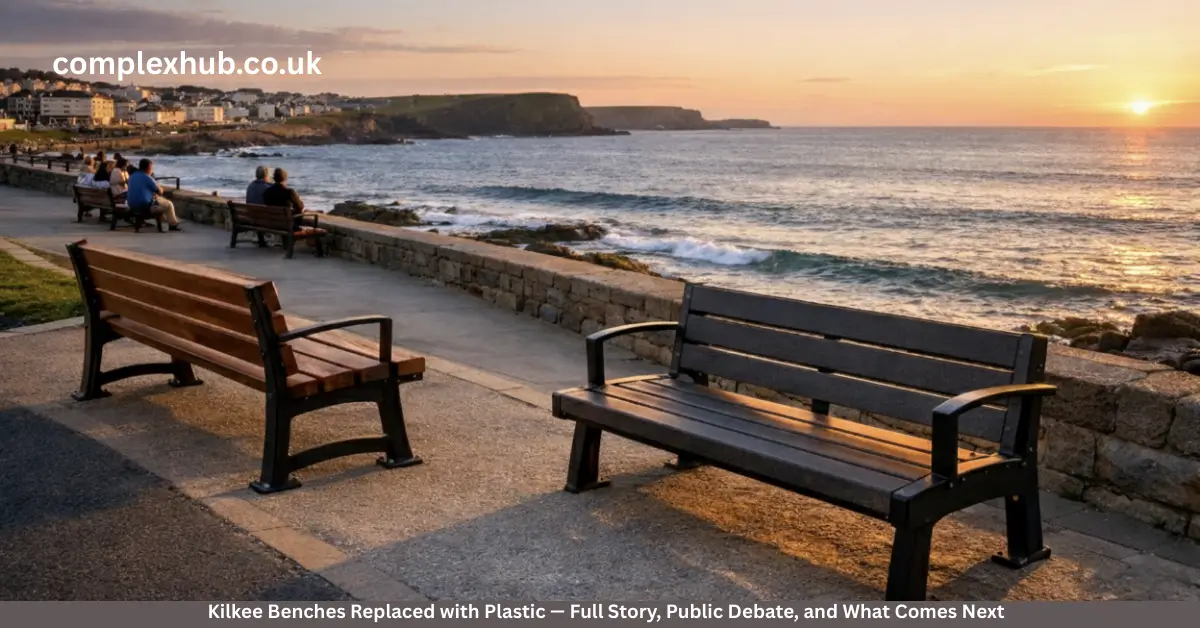
Introduction – A Small Change That Sparked a Big Conversation
In 2025, visitors walking along Kilkee’s scenic seafront noticed a quiet but meaningful transformation.
Several of the town’s long-familiar blue-and-white wooden benches had been removed and replaced with brown benches made from recycled plastic.
To some, this was a routine infrastructure upgrade focused on safety and sustainability.
To others, it felt like the disappearance of a cherished symbol of local identity.
What might normally have been a minor municipal decision quickly evolved into a wide public debate—spreading across social media, community discussions, and regional news—touching on deeper themes such as:
- Heritage versus modernization
- Sustainability versus tradition
- Public consultation and civic trust
- The emotional meaning of everyday public spaces
Understanding the Kilkee bench controversy requires looking beyond the furniture itself to the values and memories those benches represented.
The Cultural Meaning of Kilkee’s Blue-and-White Benches
For decades, Kilkee’s seafront benches formed part of the town’s visual signature.
Painted in blue and white—colours often associated with local pride and Gaelic Athletic Association (GAA) identity—they framed postcard views of the Atlantic coastline.
Over time, these benches became more than seating:
- Landmarks for residents and tourists
- Symbols of continuity across generations
- Quiet gathering places for conversation, reflection, and routine walks
Public furniture rarely attracts attention—until it disappears.
In Kilkee, the removal of the benches felt to many like a loss of familiarity and belonging, not merely a design update.
Why the Benches Were Replaced
Local authorities pointed to several practical and legal responsibilities behind the decision.
1. Safety and Structural Deterioration
Coastal environments are particularly harsh on timber.
Salt spray, moisture, wind, and temperature shifts accelerate:
- Rotting of wooden slats
- Rusting of metal fixtures
- Instability that can pose injury risks
Councils carry a duty of care to maintain safe public infrastructure, making replacement unavoidable once deterioration reaches a critical level.
2. Ongoing Maintenance Costs
Wooden benches demand continuous upkeep:
- Sanding and repainting
- Anti-rot treatments
- Replacement of damaged sections
Over many years, these recurring expenses can exceed the cost of installing long-life alternative materials, especially within limited municipal budgets.
3. Sustainability Goals
Kilkee has participated in environmental and waste-reduction initiatives, and recycled-plastic benches align with broader sustainability strategies by:
- Reusing post-consumer plastic waste
- Reducing demand for new timber
- Lowering maintenance-related chemical use
From an infrastructure perspective, the switch represented a durability and environmental decision, not solely an aesthetic one.
What Are Recycled-Plastic Benches?
Most recycled benches are manufactured from high-density polyethylene (HDPE) or similar composites derived from processed plastic waste.
Advantages
- Strong resistance to rot, insects, and moisture
- Minimal maintenance requirements
- Long service life in coastal climates
- Potential recyclability at end of use
- Lower lifetime cost despite higher upfront price
Limitations
- Less traditional appearance than timber
- Energy required in plastic processing
- Possible long-term microplastic concerns depending on material quality
Technically, recycled plastic performs well.
Emotionally and culturally, however, materials carry meaning—and this became the heart of Kilkee’s debate.
Community Reaction — A Town Divided
Support for the Change
Some residents welcomed the replacement as:
- A practical safety measure
- A financially responsible decision
- A step toward environmental sustainability
For these voices, durability and reduced maintenance outweighed nostalgia.
Backlash and Emotional Response
Others viewed the removal as:
- A loss of heritage and visual identity
- Evidence of insufficient public consultation
- A shift toward generic design lacking local character
The intensity of feeling revealed that the issue was not really about benches—but about belonging, memory, and civic voice.
Heritage vs. Sustainability — A Wider Modern Tension
Kilkee’s experience mirrors challenges faced by towns worldwide.
Heritage perspective:
- Public spaces hold cultural meaning.
- Visual continuity supports tourism and pride.
- Traditional materials reflect identity.
Sustainability perspective:
- Durable materials reduce environmental impact over time.
- Maintenance chemicals and timber use decline.
- Climate resilience becomes essential.
The real challenge is integration rather than opposition—designing solutions that honor both.
Economic and Environmental Realities
Economic View
Recycled plastic benches often deliver lower total cost over 10–20 years due to:
- Reduced repainting and repair
- Longer lifespan
- Lower labour demands
However, initial purchase costs can be higher than timber.
Environmental View
Positive impacts:
- Diverts plastic from landfill
- Reduces timber harvesting
- Cuts maintenance chemicals
Potential concerns:
- Manufacturing emissions
- Recycling availability at end of life
- Microplastic wear over decades
Overall impact depends on lifespan, quality, and disposal systems.
Coastal Climate Pressures
Kilkee’s Atlantic location creates infrastructure challenges:
- Salt corrosion
- Storm exposure
- Strong winds
- Moisture-driven decay
Climate resilience increasingly shapes municipal material choices—explaining the appeal of long-lasting composites.
The Role of Public Consultation
A central criticism in Kilkee was perceived lack of community input.
Effective consultation can:
- Build trust
- Improve design acceptance
- Surface local knowledge
- Reduce backlash
Best practices include:
- Public meetings
- Visual design previews
- Pilot installations
- Transparent safety explanations
Process, not just outcome, shapes public response.
Design, Identity, and Sense of Place
Benches contribute to:
- Town character
- Tourism imagery
- Daily emotional experience
Even subtle visual changes can alter how residents feel about home.
Sustainable infrastructure must therefore consider aesthetic continuity, not only durability.
Possible Alternative Approaches
Several compromise solutions might have balanced tradition and resilience:
- Hybrid wood-and-recycled-plastic designs
- Colour-matched plastic in blue and white
- Treated or reclaimed timber with advanced coatings
- Pilot testing with community feedback
- Artist- or resident-designed seating
These illustrate that heritage and sustainability can coexist through thoughtful design.
Lessons for Other Coastal Towns
Kilkee offers broader insights:
- Consultation is essential for trust.
- Design carries cultural weight.
- Sustainability must feel local, not imposed.
- Pilot programs reduce conflict.
- Heritage should guide modernization.
Key Facts
- Replacement occurred during 2025 seafront updates.
- Roughly dozens of benches were initially changed (early local reporting).
- Decision linked to safety, maintenance, and sustainability.
- Generated significant community discussion.
FAQs
Why were the benches replaced?
Safety concerns, maintenance costs, and sustainability goals.
Are plastic benches better than wood?
More durable and lower maintenance—but less traditional in appearance.
Could heritage have been preserved?
Yes, through hybrid materials, colour matching, or phased consultation.
Was the public consulted?
Some residents felt consultation was limited, fueling debate.
Final Thoughts — Kilkee’s Opportunity Moving Forward
The Kilkee bench story is ultimately about how communities navigate change.
It shows that:
- Infrastructure decisions are also cultural decisions.
- Sustainability succeeds best when paired with identity.
- Listening can matter as much as engineering.
Kilkee now has an opportunity to become a model for heritage-sensitive sustainability—proving that progress does not require forgetting the past.
Because in every town, even the simplest bench can hold something profound:
memory, belonging, and the quiet meaning of home.
Read More :- Repmold